Sintra
Sintra & Cabo da Roca - Private Van Tour
5.0(8,879)rated 5.0 out of 5 from 8879 reviews 8 hours
Free cancellation
from $422.93
Loading experience…
From$137.32per person
$274.64 for 2 adults, the minimum per booking
Final price, including all taxes and fees
Guimarães has one of the best preserved medieval centers of Portugal, where time seems to have really given way and magically stopped.
Come to know more than the history and monuments of Guimarães. Visit the suburbs of the city, with its traditions, historical and cultural heritage, local gastronomy and its nature.
It's Historic Center is classified as World Heritage Site by UNESCO, is a historical city of medieval origin and has its origin in the tenth century, known as “Cradle of the Nation” or “Cradle City”, for its crucial role in the formation of Portugal, and here the first Portuguese King was born.
Highlights:
• Full day tour (9h)
• Pickup & Drop-off
• Entrance to monuments
• UNESCO Heritage site
• Photos of the tour
• Small groups (max. 6 pax)
Head straight to the meeting point, or get picked up.
Pickup
The operator picks you up about 5 minutes before the start time. You choose your pickup place at checkout.
Meeting point
R. de Guilherme da Costa Carvalho 38
38 R. de Guilherme da Costa Carvalho, Porto Porto, 4000-125
Open in Google MapsMeet at R. de Guilherme da Costa Carvalho 38
Or choose pickup from your hotel
Guimarães Castle: Portugal was born here
Rua Conde Dom Henrique, 4800-412 Guimaraes
«The Guimarães Castle is widely recognized as the closest one to the origins of Portugal and it presents a surprising infrastructure on many levels. First of all due to its origins, which are singularly unclear. It is safe to say that we are dealing with a count’s edifice, fruit of the charismatic Countess of Portucale Mumadona. As the castle is not mentioned in a detailed document, dated of 950, that divided goods between the Countess and her children, we can conclude that, at that time, it did not yet exist. But by the end of that year, the castle is mentioned in a donation to the Guimarães Monastery. Hence it is recognized as of count’s foundation in the second half of the 10th century. Countess Mumadona herself declared, in a parchment dated of 968, that she had the castle built in order to protect the previously mentioned Monastery against “Gentile” attacks (referring probably to the Normans). This primitive castle, embedded within the granite outcrops, was probably made out of wood and there are few traces left of it.
In the late 11th century, during the rule of the counts Henrique and Teresa, the castle underwent a profound restructuring, which traces are mostly in the northern facade, facing the S. Mamede Camp, where large stones at the base of the walls sign a different constructions’ phase. These traces indicate that the construction was originally round. It was this castle that faced Alfonso VII of León and Castile, when the monarch sieged the young Afonso Henriques.
In the 12th century, during the rule of the first Portuguese King, the castle underwent another profound improvement, from which it began to assume its present perimeter, although it lacked its eight towers. With its Gothic reforms, during the reigns of Afonso III and Dinis (when the Guimarães walls were being restructured), it went through another profound modification, which added the eight turrets (four of which frame the two existing doors) as well as the keep.
On the second half of the 13th century the Guimarães Castle finally acquired its present form. By that time the Kingdom borders were already safe enough, giving it an increasing secondary role. But it still played a decisive role in the 1321-24 Civil War – pitting Dinis against the heir to the throne Prince Afonso – that culminated on the 1322 Siege. Its importance was again tested in the 1383-85 Crisis, when the Grand Master of the Order of Avis sieged it.
During the 15th century the castle retained some relevance, but at the end of said century its military and strategic importance ran dry. The borders were now distant enough and weaponry evolved into ballistic with the introduction of firearms. On the early years of the 16th century, the Guimarães Castle began to be neglected and decayed. As it had no military role, it began to be used as a prison. It was only in the 19th century that the people of Guimarães, in its wake, as well as the Portuguese reconciled with the Castle. From the 19th century onwards it came to be recognized as an emblematic structure of the Portuguese Middle Ages, closely associated with the autonomic process in which, truly, it played a reduced role. It was classed as a National Monument in 1881 – as part of the first Portuguese list that classed Monuments – and it undeniable acquired a symbolic value that led to a deep reform between 1936 and 1940. The Guimarães Castle is, still today, one of the most iconic and well-recognized medieval castles in Portugal.»
By Mário Jorge Barroca
Church of São Miguel do Castelo
between Castelo and Paco dos Duques de Braganca, 4810-245 Guimaraes
The Church of São Miguel do Castelo is intrinsically linked to Guimarães Castle and the foundation of the Portuguese nation, as it is believed that the first king of Portugal - Afonso Henriques - was baptized here. The oldest known reference to the church of S. Miguel do Castelo dates back to 1216. In medieval times, it was under its porch that some town council hearings were held, making it a meeting place for matters of administration and sociability. In 1664, the prior D. Diogo Lobo da Silveira removed the baptismal font from the Church of S. Miguel and moved it to the Church of Nossa Senhora da Oliveira. Over the centuries, it has undergone several processes of ruin and restoration. In September 1927, it returned to its original location. And it returned for exactly the same reason it had been taken - to enhance the baptismal font in which King Afonso Henriques was believed to have been baptized.
Dukes of Bragança palace
Rua Conde Dom Henrique, , 4800-412 Guimaraes
It was built by the eighth Count of Barcelos (later the first Duke of Bragança), Afonso, the illegitimate son of King João I. Its construction took place between 1420 and 1433 and must have begun during Afonso's second marriage to Constança de Noronha.
It is thought that during the 1500s the palace was still used as the residence of the Dukes of Bragança, but then gradually fell into a phase of abandonment and consequent ruin. In the 19th century, during the French invasions, the palace was converted into military barracks. And in the following century, during the Estado Novo regime, the Paço dos Duques was rebuilt between 1937 and 1959.
It was inaugurated on June 25, 1959. The pieces decorating the rooms open to the public are intended to create the illusion that visitors are entering an inhabited house. The tapestry, furniture, ceramics, painting and armory collections are particularly noteworthy.
Convent of Carmo
Largo Martins Sarmento, Guimarães
The construction of the church and convent of Carmo began in 1685 and is evidence of the Baroque style. The convent was dedicated to Saint Teresa. At the beginning of the 1700s, a papal bull authorized those gathered at Saint Teresa's to take the veil of Discalced Carmelite nuns, already under the invocation of Saint Joseph. However, the main altar was occupied by the image of Our Lady of Mount Carmel - the most common and well-known invocation. The body of the church is divided from the chancel by a stone arch and is enriched by two side altars: that of the Gospel, dedicated to St. Anne; that of the Epistle, to Our Lady of Mount Carmel. In the old choir there is another altar, dedicated to the Dead Lord, which has now been erected by particular initiative and devotion. With the official extinction of the religious orders, the church and convent passed into state ownership and were used for military purposes. In 1862, the building became home to the current Lar de Santa Estefânia.
Rua Santa Maria
4800 Guimaraes
It was one of the first streets build in Guimarães, as it was intended to connect the convent founded by Mumadona, surrounded by the lower part of the town, and the Castle located in the upper part of the town. It is already referred to by this name in documents dating back to the 12th century. Along its route we find various architectural testimonies of its past: the Convent of Santa Clara, the Casa do Arco, the Casa dos Peixotos and the Gothic Casa dos Valadares, and many others that give it its own identity and characteristics in the city of Guimarães and also know as the preferred area of residence of the city´s dignitaries: the clergy, nobility and well-to-do merchants.
Santa Clara Convent
Largo Cónego José Maria Gomes, Guimarães
It was one of the richest convents in Guimarães, established in the 16th century by Canon Baltasar de Andrade, Master School of the Collegiate Church of Our Lady of Oliveira. The building features a Baroque façade and a sculpture of Saint Clare in the center. The two-story cloister is classical in style. Its rich chapel was emptied in the 19th century, and today some of the gilded carvings are housed in the Alberto Sampaio Museum. This building houses the Guimarães City Hall.
Medieval streets
Largo da Oliveira, , 4810-431 Guimaraes
The historic town of Guimarães is associated with the emergence of the Portuguese national identity in the 12th century. An exceptionally well-preserved and authentic example of the evolution of a medieval settlement into a modern town, its rich building typology exemplifies the specific development of Portuguese architecture from the 15th to 19th century through the consistent use of traditional building materials and techniques.
Nossa Senhora da Oliveira Church
Largo da Oliveira s/n, Centro Histórico, 4800-438 Guimaraes
The origins of the Insigne e Real Colegiada de Nossa Senhora da Oliveira date back to the monastery dedicated to the Savior of the World, the Virgin of Santa Maria and the Holy Apostles, founded by Countess Mumadona Dias around 950. The invocation of Our Lady of the Olive Tree prevailed after 1342, with the sprouting of an olive tree in the front square. The current building is evidence of successive renovations and additions, incorporating elements from different periods - the Gothic reconstruction promoted by King João I; the Manueline church tower, completed around 1513-1515; the chancel, of classical architecture, rebuilt in the 17th century by King Pedro II; the church's main chapel. The stuccoes in the main and side chapels are references to the neoclassical renovation begun in 1830; the last intervention dates back to the 20th century and aimed to leave the granite of the walls and the columns of medieval origin visible. Classified as a national monument since 1910.
Largo da Oliveira square
4810 Guimaraes
The Largo da Oliveira owes its name to a centuries-old olive-tree planted on this same site. Surrounded by picturesque houses that are typical of the north of Portugal, it is the ideal starting point for a walking tour of the city´s streets. But, in the square itself, there are also a number of interesting features: on the eastern side is a curious Gothic shrine, built in the reign of D. Afonso IV to commemorate the Battle of Salado, where the Portuguese and Castilian forces together defeated the Moorish army from Granada, in 1340. Behind this is the Igreja de Nossa Senhora de Oliveira (or the Igreja da Colegiada - the Collegiate Church of Our Lady of the Olive-Tree), which is the first Gothic monument to have been built in the Minho, under the auspices of D. João I and in fulfilment of a vow that he made in return for victory against the Castilian army in the Battle of Aljubarrota (1385).
Top of the Penha mountain
4800-179 Guimaraes
At the top of the Penha mountain, you will find the Sanctuary of Nossa Senhora da Penha, a well-known pilgrimage site. The chapel, built in 1652, served as a Convent of the Imaculada Conceição as early as 1727. While visiting the Sanctuary, be dazzled by the stunning set of tiles and gorgeous pulpit. When up there, discover and explore several caves and enjoy the magnificent sights that the natural viewpoints give you. The Penha mountain offers a wide range of activities: a mountain campsite, a mini golf course, an outdoor exercise area, an equestrian center, a picnic area, pedestrian tracks, restaurants, bars and coffee shops.
The operator will ask for: Arrival Airline, Arrival Flight No, Arrival Time, Departure Airline, Departure Flight No, Departure Date, Departure Time, Cruise Ship, Disembarkation Time, Cruise Ship.
Operated by Trek Portugal
Cancel up to 24 hours before the start time for a full refund. Cancellations after that, or no-shows, are not refunded.
How cancellations and refunds workSintra
Free cancellation
from $422.93

Lisboa
Free cancellation
from $175.77
Lisboa
Free cancellation
from $439.41
Palmela
Free cancellation
from $527.29

Lisbon
Free cancellation
from $263.65
Lisbon
Free cancellation
from $823.88
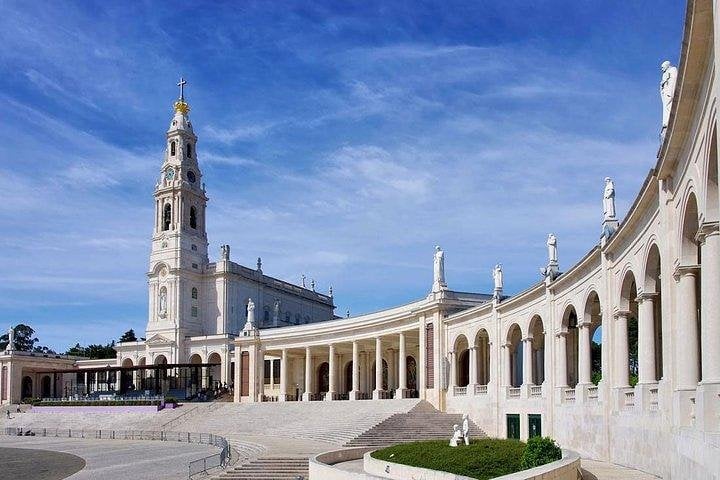
Fátima
Free cancellation
from $494.33
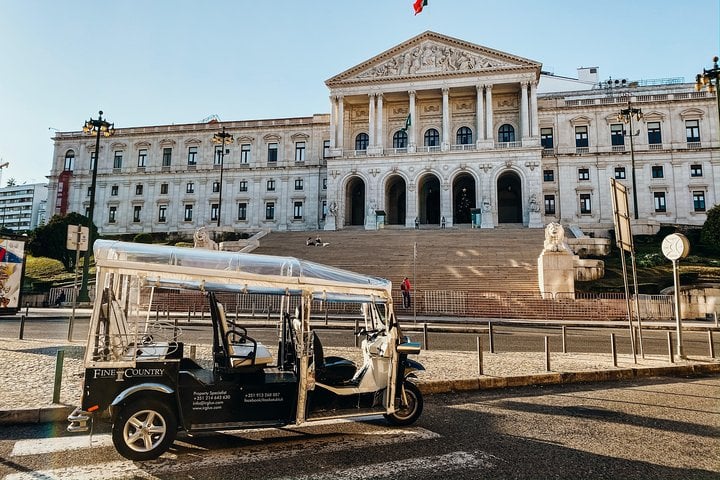
Lisboa
Free cancellation
from $98.87
from
$137.32 per person