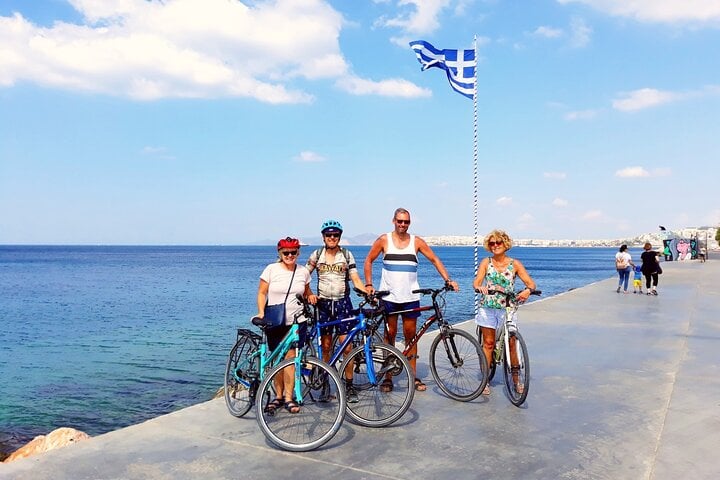
Athens
ATHENS CITY & SEA E-BIKE TOUR
5.0(6,457)rated 5.0 out of 5 from 6457 reviews 4 hr 30 min
Free cancellation
from $42.85
Loading experience…
From$472.36per person
Final price, including all taxes and fees
A day trip from Athens to see Thermopylae and Delphi is an unforgettable experience. This full-day tour begins by driving north from Athens, we arrive at Thermopylae, the historical Pass of Thermopylae where the battle took place between the Persians and Spartans. Our next stop is going to be the sacred site of Delphi with its Temple of Apollo. Delphi is a UNESCO-recognized archeological site that’s among Greece’s most iconic places. Follow in the footsteps of ancient heroes across the countryside of Greece on an adventure that takes you to the heart of this European country.
Pickup
The operator picks you up. You choose your pickup place at checkout.
Pickup from your hotel or a nearby point
Athens City
Pick-up from Athens City
Thermopylae
The Battle of Thermopylae was fought between an alliance of Ancient Greek city-states, led by King Leonidas of Sparta, and the Achaemenid Empire of Xerxes. It was fought in 480 BC over the course of three days, during the second Persian invasion of Greece.
Leonidas Monument
Leonidas was a king of the Greek city-state of Sparta, and the 17th of the Agiad line, a dynasty which claimed descent from the mythological demigod Heracles and Cadmus. Leonidas was son of King Anaxandridas II. He succeeded his half-brother King Cleomenes I to the throne in c. 489 BC.
Leonidas had a notable participation in the Second Persian War, where he led the allied Greek forces to a last stand at the Battle of Thermopylae (480 BC) while attempting to defend the pass from the invading Persian army; he died at the battle and entered myth as the leader of the 300 Spartans. While the Greeks lost this battle, they were able to expel the Persian invaders in the following year.
Hot Springs of Thermopylae
Thermopylae means "hot gates," in reference to the presence of the hot sulphur springs in the area. The cavernous entrance to Hades, the underworld of Greek mythology, was said to be at Thermopylae. The Greeks were among the first to discover the beneficial properties of water. They used it not only for cleanliness and therapy, but also for relaxation. At first, unable to understand the actual curative capability of water, they (like other ancient people, such as the Egyptians, Babylonians, Persians and Indians) simply worshiped it as a deity and ascribed supernatural and magical powers to it. Early Greek texts and myths confirm this: Achilles, for instance, was invincible because his mother, Thetis, dipped him as a baby in the magical waters of the River Styx. As she held him by his heel, it remained the one vulnerable spot – his Achilles heel – which became the target of Paris’ arrow in the Trojan War. Heracles, another legendary hero, regained his strength after completing each feat by bathing in the hot springs at Thermopylae, which the god Hephaestus had created for him at the behest of the goddess Athena.
Delphi
Free time for lunch at a traditional greek tavern at Delphi.
The Tholos of Delphi
The Tholos of Delphi is among the ancient structures of the Sanctuary of Athena Pronaia in Delphi. The circular temple, a tholos, shares the immediate site with other ancient foundations of the Temple of Athena Pronaia, all located less than a mile east of the main ruins at Delphi, in the modern Greek regional unit of Phocis. The tholos is part of the Delphi UNESCO World Heritage Site.
Delphi Archaeological Museum
Delphi Archaeological Museum is one of the principal museums of Greece and one of the most visited. It is operated by the Greek Ministry of Culture. Founded in 1903, it has been rearranged several times and houses the discoveries made at the Panhellenic sanctuary of Delphi, which dates from the Late Helladic (Mycenean) period to the early Byzantine era. Organized in fourteen rooms on two levels, the museum mainly displays statues, including the famous Charioteer of Delphi, architectural elements, like the frieze of the Siphnian Treasury, and ex-votos dedicated to the sanctuary of Pythian Apollo, like the Sphinx of Naxos.
Delphi Archeological Site
Visit Delphi archeological site, a UNESCO-recognized archeological site that’s among Greece’s most iconic places. In ancient times was a sacred precinct that served as the seat of Pythia, the major oracle who was consulted about important decisions throughout the ancient classical world.
The Temple of Apollo, god of music, harmony, light, healing, and oracles occupied the most important and prominent position in the Delphic Panhellenic Sanctuary. The edifice with the partially restored colonnade visible today dates to the 4th century BC; it is the third temple built at the same place. The famous oracle, the Pythia, operated inside the temple, the location chosen, according to one tradition, due to a sacred chasm beneath the site emitting vapors, which were inhaled by the Pythia. Some ancient writers state that the Pythia then entered a state of delirium and uttering inarticulate cries, which were then turned into equivocal oracles by the priests
Arachova
Free time to take a few pictures before we start our trip back to Athens.
Way back to Athens
We start our way back to Athens.
Operated by LS TOURS IKE
Cancel up to 24 hours before the start time for a full refund. Cancellations after that, or no-shows, are not refunded.
How cancellations and refunds workAthens
Free cancellation
from $42.85
Athens
Free cancellation
from $38.45
Athens
Free cancellation
from $38.45
Athens
Free cancellation
from $38.45
Athens
Free cancellation
from $82.39

Fira
Free cancellation
from $108.76

Athens
Free cancellation
from $76.90
Fira
Free cancellation
from $98.87
from
$472.36 per person